Basal Dental Implants in Pune: Cost, Procedure, Benefits and Complete Guide
Missing teeth can affect your ability to chew, speak comfortably and smile with confidence. When teeth are lost for a long time, changes in the supporting jawbone can also occur. Dental implants are an established option for replacing missing teeth, but the ideal implant approach depends on each patient's bone condition, oral health, bite and treatment requirements.
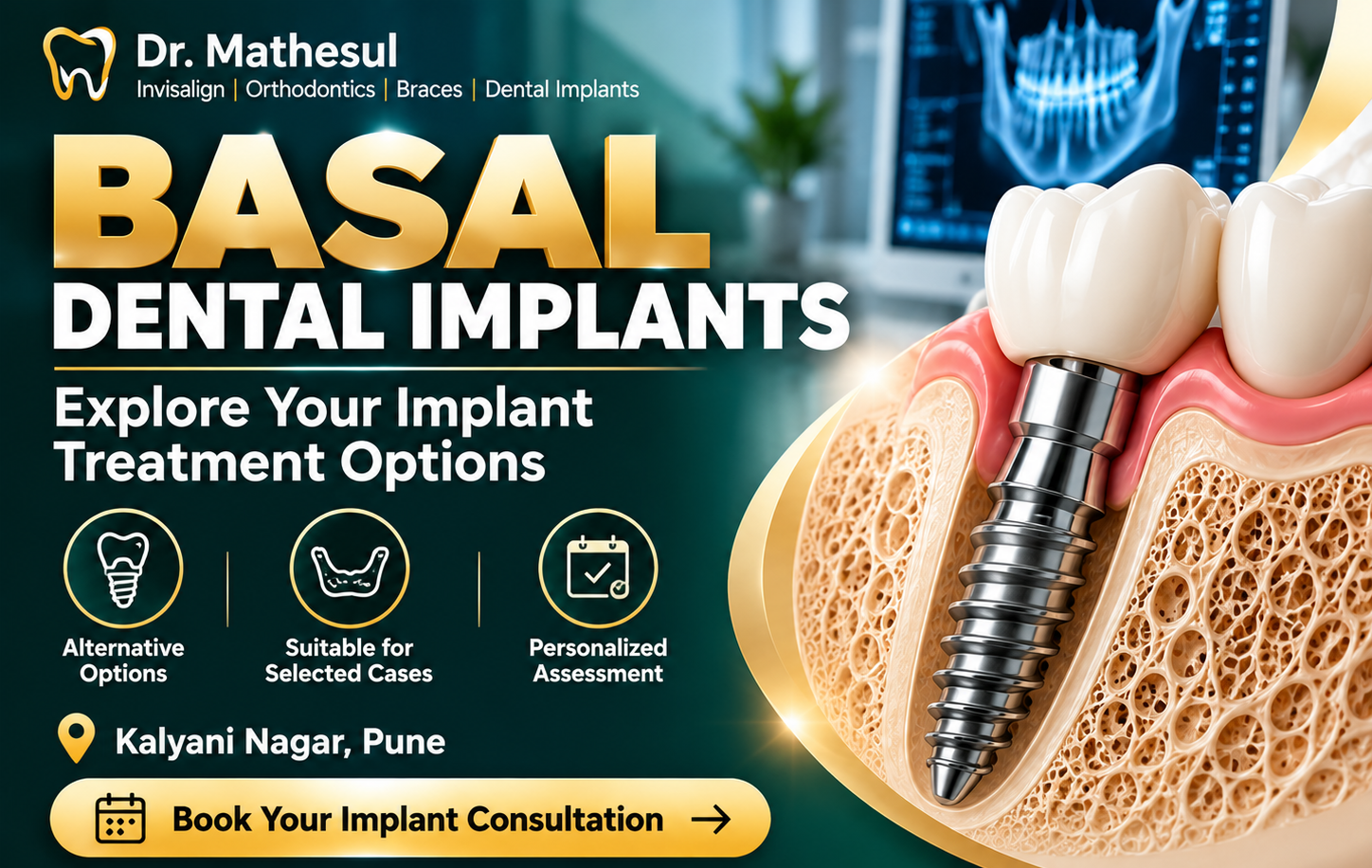
For patients searching for basal dental implants in Pune, basal implant treatment may be considered in selected situations where a different approach to implant support is required. Basal implants are designed to obtain support from denser areas of the jawbone and may be used as part of a comprehensive tooth-replacement or full-mouth rehabilitation plan.
At Dr. Mathesul Clinic in Kalyani Nagar, Pune, dental implant treatment is planned according to the patient's individual condition. Factors such as available bone, gum health, missing teeth, bite, aesthetics, medical history and overall treatment goals are considered before recommending an implant solution.
This guide explains what basal dental implants are, who may be considered for basal implant treatment, the procedure, basal implants cost in Pune, full-mouth basal implants, potential benefits, safety, longevity and the difference between basal and conventional dental implants.
What Are Basal Dental Implants?
Basal dental implants are a type of dental implant designed to obtain support from denser portions of the jawbone. Depending on the implant system and treatment approach, they may also be described as basal implants, basal teeth implants, basal bone dental implants or cortical implants.
Conventional dental implant planning commonly focuses on the available alveolar bone. Basal implant approaches may instead utilize denser cortical or basal areas of the jaw for implant support.
This distinction can be relevant when evaluating patients who have experienced substantial bone loss or have limited available bone for conventional implant placement.
However, basal implants are not automatically the best option for every patient with missing teeth or bone loss. Implant selection should be based on a detailed clinical assessment.
Factors that may influence treatment planning include:
- Number and location of missing teeth
- Condition and volume of the available jawbone
- Gum and periodontal health
- Bite and occlusion
- Condition of the remaining teeth
- Existing dental restorations
- General oral health
- Medical history and healing considerations
- Functional and aesthetic expectations
A dental implant professional can assess these factors and explain whether basal implants, conventional implants or another treatment option is appropriate.
Who May Be Considered for Basal Dental Implants?
Patients with different patterns of tooth loss may be evaluated for basal dental implant treatment.
Basal implants may be considered in selected cases involving reduced bone availability or extensive tooth loss where the clinician needs to evaluate alternative implant-support strategies.
Depending on the individual case, basal implants may be considered for patients with:
- Multiple missing teeth
- Extensive tooth loss
- Significant jawbone resorption
- Reduced available bone for conventional implant placement
- Loose or failing teeth requiring replacement
- A need for fixed tooth-replacement options
- Selected full-mouth rehabilitation cases
It is important to understand that having bone loss does not automatically mean that basal implants are required.
Other approaches, including conventional implants, bone augmentation, bridges, dentures or other restorative solutions, may also be considered depending on the patient's anatomy and treatment goals.
A proper examination and appropriate dental imaging are therefore important before choosing an implant treatment.
Basal Dental Implant Procedure: Step-by-Step
The basal dental implant procedure varies depending on the number of missing teeth, jaw anatomy, treatment objectives and final restoration.
A typical treatment pathway may involve the following stages.
1. Initial Consultation and Dental Examination
The first step is a detailed consultation.
The dentist evaluates the missing teeth, remaining teeth, gums, bite, oral hygiene and general oral condition. Your medical and dental history may also be reviewed because certain medical conditions and medications can influence dental treatment and healing.
This assessment helps determine which treatment options should be considered.
2. Dental Imaging and Implant Planning
Dental imaging is an important part of implant treatment planning.
Depending on the individual case, the dentist may recommend appropriate dental radiographs or three-dimensional imaging such as a CBCT scan.
Imaging helps evaluate the anatomy of the jaw, available bone and relevant anatomical structures. It can also assist with planning the position and number of implants required.
3. Basal Implant Placement
If basal implant treatment is selected, the implants are surgically placed according to the planned treatment approach.
The number, position and type of implants depend on the patient's individual anatomy and restorative requirements.
Implant placement should be performed using appropriate clinical protocols and careful treatment planning.
4. Temporary or Definitive Teeth
Depending on the treatment plan, temporary teeth may be provided during the rehabilitation period.
In selected cases, immediate loading or early restoration may be considered. However, this depends on factors such as implant stability, bone condition, bite forces and the clinician's assessment.
Immediate teeth should therefore not be assumed to be appropriate for every basal implant patient.
5. Follow-Up and Final Restoration
Follow-up is an important part of implant treatment.
The dental team can monitor healing, oral hygiene, bite and the condition of the implant-supported restoration.
The final restoration is planned to provide appropriate function and aesthetics based on the patient's individual requirements.
Basal Implants vs Conventional Dental Implants
One of the most common questions patients ask when researching basal dental implants in Pune is whether basal implants are better than conventional dental implants.
Both approaches are used for tooth replacement, but their treatment planning and the areas of bone used for implant support can differ.
| Feature | Basal Dental Implants | Conventional Dental Implants |
|---|
| Bone support | May engage denser cortical or basal bone | Commonly placed in available alveolar bone |
| Treatment planning | Depends on individual anatomy | Depends on individual anatomy |
| Patients with bone loss | May be considered in selected cases | May require additional procedures depending on bone availability |
| Multiple missing teeth | Can be considered for selected cases | Commonly used for multiple missing teeth |
| Full-mouth rehabilitation | May be considered in selected cases | Commonly used for full-mouth rehabilitation |
| Suitability | Requires individual clinical assessment | Requires individual clinical assessment |
There is no universal answer to which implant approach is "better."
The appropriate option depends on factors such as your jaw anatomy, bone condition, oral health, bite, number of missing teeth, aesthetic requirements and overall treatment objectives.
If you are comparing basal implants vs conventional implants, ask your dentist about the expected benefits, limitations, treatment stages, alternatives and long-term maintenance requirements before making a decision.
Basal Dental Implants Cost in Pune
The basal dental implants cost in Pune varies from patient to patient. There is no single price that applies to every basal implant case.
The overall treatment cost may depend on:
- Number of implants required
- Number and location of missing teeth
- Condition of the jawbone
- Type and quality of implant system
- Type of final prosthesis
- Diagnostic imaging and treatment planning
- Additional dental procedures
- Complexity of the bite and rehabilitation
- Materials selected for the final restoration
- Follow-up and maintenance requirements
Patients searching online for basal implants cost, basal implants price, basal dental implants cost in India or basal implants cost in Pune should avoid comparing prices based only on the implant itself.
A quoted treatment price may or may not include diagnostic imaging, surgical procedures, temporary teeth, final prosthetic teeth and other components of treatment.
The most appropriate way to understand the cost of basal dental implants is to undergo a dental examination and receive a personalized treatment plan.
At Dr. Mathesul Clinic in Kalyani Nagar, Pune, the recommended treatment and associated costs can be discussed after evaluating your individual dental requirements.
Full Mouth Basal Implants
Patients who have lost many or all of their teeth may search for full mouth basal implants as a possible treatment option.
Full-mouth implant rehabilitation is more complex than replacing a single missing tooth. The treatment plan needs to consider the entire relationship between the jaw, remaining tissues, bite and replacement teeth.
Important considerations may include:
- Jaw anatomy
- Available bone
- Implant positioning
- Bite and chewing forces
- Facial aesthetics
- Gum and soft-tissue condition
- Number and distribution of implants
- Design of the final prosthetic teeth
- Long-term maintenance
The objective of full-mouth rehabilitation is not simply to replace individual missing teeth. Treatment planning needs to consider an appropriate combination of function, stability, appearance and oral health.
Whether basal implants are suitable for a particular full-mouth case can only be determined after clinical and radiographic evaluation.
Potential Benefits of Basal Dental Implants
Depending on the individual patient's circumstances, basal implant treatment may offer potential advantages.
May Be Considered in Selected Bone-Loss Cases
Basal implant approaches may engage denser areas of the jaw and can therefore be considered for selected patients with reduced bone availability.
However, this does not mean that every patient with bone loss can avoid bone augmentation or other procedures. The need for additional treatment must be assessed individually.
Fixed Tooth Replacement
For suitable patients, implant-supported teeth can provide a fixed alternative to removable dentures.
The exact type of restoration depends on the patient's treatment plan and clinical requirements.
Functional Tooth Replacement
Implant-supported restorations are designed to restore chewing function and help patients achieve a more natural eating pattern, subject to appropriate treatment planning and healing.
Aesthetic Rehabilitation
A properly planned implant restoration can also help restore the appearance of a smile by replacing missing teeth and supporting an appropriate tooth shape and position.
Full-Mouth Rehabilitation
Basal implants may be considered as part of a comprehensive rehabilitation plan for selected patients with extensive tooth loss.
The treatment should be individualized rather than based on a one-size-fits-all approach.
Are Basal Dental Implants Safe?
Like other surgical dental procedures, implant treatment has potential risks and requires appropriate planning.
The safety and suitability of basal dental implants depend on several factors, including:
- Oral and periodontal health
- Medical history
- Jawbone anatomy
- Implant planning
- Surgical technique
- Oral hygiene
- Bite and chewing forces
- Follow-up care
Potential complications associated with dental implant treatment can include infection, discomfort, swelling, implant failure, damage to surrounding structures and problems involving the implant-supported restoration.
Patients should therefore be cautious about treatment claims such as "100% success," "no bone graft required for everyone" or guaranteed immediate teeth.
Treatment outcomes vary between individuals.
A responsible implant treatment process includes appropriate examination, imaging when required, informed consent, careful treatment planning and professional follow-up.
How Long Do Basal Dental Implants Last?
Patients often ask, "How long do basal dental implants last?"
There is no fixed lifespan that applies to every implant patient.
The longevity of an implant and its restoration can be influenced by several factors, including:
- Oral hygiene
- Gum health
- Smoking or tobacco use
- Bite forces
- General health
- Implant position
- Quality and condition of the restoration
- Regular dental examinations
- Proper maintenance
Dental implants require ongoing care. Even after successful implant treatment, patients should maintain good oral hygiene and attend regular dental check-ups.
Can Basal Implants Be Used After Bone Loss?
Bone loss is one of the reasons patients may explore basal dental implants.
When teeth are missing for an extended period, the jawbone can gradually resorb. This may make conventional implant planning more challenging in some cases.
Basal implant treatment may be considered for selected patients depending on the remaining bone anatomy.
However, bone loss does not automatically mean that basal implants are the best treatment option.
Depending on the individual case, other possibilities may include conventional dental implants with bone augmentation or different restorative solutions.
A clinical examination and appropriate imaging, such as CBCT when indicated, can help the dentist evaluate the available anatomy and develop an appropriate treatment plan.
Basal Dental Implants Near Me in Pune
Patients searching for basal implants near me, basal dental implants Pune or a dental implant clinic in Pune should consider more than proximity or advertised price.
Important questions to consider include:
- Will my jawbone and oral health be properly evaluated?
- Will the dentist explain different implant options?
- Is appropriate dental imaging recommended when required?
- Are the risks and limitations explained?
- What type of final restoration is being planned?
- What follow-up and maintenance will be required?
- Are alternative treatment options discussed?
A personalized consultation can help you understand whether basal implant treatment is appropriate for your particular condition.
Frequently Asked Questions About Basal Dental Implants
What are basal dental implants?
Basal dental implants are dental implants designed to obtain support from denser areas of the jawbone. They may be considered for selected patients, including some individuals with significant bone loss.
What is the cost of basal dental implants in Pune?
The cost varies according to the number of implants, jawbone condition, type of restoration, implant system, treatment complexity and any additional procedures required. An accurate estimate requires individual clinical assessment.
Are basal implants better than conventional implants?
Not necessarily. Basal and conventional implants involve different treatment approaches. The appropriate option depends on the patient's anatomy, oral health, bone condition and treatment objectives.
Can basal implants be used for full-mouth rehabilitation?
Basal implants may be considered as part of full-mouth rehabilitation for selected patients with extensive tooth loss. The appropriate treatment plan depends on jaw anatomy, bite, implant positioning and restorative requirements.
Are basal implants suitable for patients with bone loss?
They may be considered for selected patients with reduced bone availability. However, bone loss alone does not determine implant selection. Clinical examination and appropriate dental imaging are necessary.
How long does basal implant treatment take?
Treatment time varies depending on the number of missing teeth, surgical requirements, restoration design, healing and individual treatment planning. Your dentist can provide a more appropriate treatment timeline after examination.
Are basal implants permanent?
Dental implants are intended as long-term tooth-replacement solutions, but their longevity varies. Oral hygiene, gum health, bite, general health, restoration quality and maintenance can all influence long-term outcomes.
Do basal implants always avoid bone grafting?
No. Treatment requirements vary between patients. Basal implant approaches may be considered in selected bone-loss cases, but whether bone augmentation or another procedure is required must be determined through individual assessment.
How do I know if basal dental implants are right for me?
The best way to determine whether basal implants are appropriate is to consult a dental implant professional. Clinical examination and appropriate imaging can help compare basal implants with conventional implants and other tooth-replacement options.
Why Choose Dr. Mathesul Clinic for Dental Implants in Pune?
Choosing dental implant treatment is an important decision. Patients should consider diagnosis, treatment planning, clinical experience, implant and restoration quality, communication and long-term follow-up rather than selecting treatment based only on price.
At Dr. Mathesul Clinic in Kalyani Nagar, Pune, dental implant treatment is planned around the patient's individual dental condition, functional requirements and smile goals.
Patients can discuss their missing-tooth concerns and understand whether basal implants, conventional implants or another restorative approach may be appropriate.
The clinic serves patients from Kalyani Nagar, Viman Nagar, Ramwadi, Wadgaon Sheri, Kharadi, Koregaon Park and other areas of East Pune.
If you are considering treatment for multiple missing teeth or extensive tooth loss, a consultation can help you understand the available options before making a treatment decision.
Book a Consultation for Basal Dental Implants in Pune
If you are searching for basal dental implants Pune, basal implants near me, basal implants cost in Pune, full mouth basal implants or a dental implant clinic in East Pune, start with a professional evaluation rather than selecting treatment based only on an online price or promotional claim.
At Dr. Mathesul Clinic, Kalyani Nagar, Pune, your missing teeth, available bone, gums, bite and treatment objectives can be evaluated before an appropriate implant solution is recommended.
A personalized consultation can help you understand:
- Whether basal implants may be suitable for your case
- Whether conventional implants may be a better option
- Whether additional procedures may be required
- The expected treatment stages
- The estimated treatment cost
- Full-mouth rehabilitation options where appropriate
- Long-term maintenance requirements
If you are considering replacing missing teeth and want to understand your implant options, schedule a consultation with Dr. Mathesul Clinic in Kalyani Nagar, Pune, and discuss a treatment plan based on your individual dental condition.