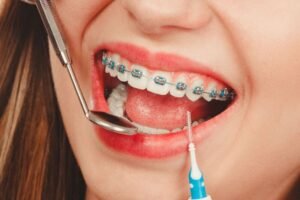
If you are currently, or thinking about, getting Invisalign treatment you might be confused to see that clear aligners can be used with different kinds of attachments and/or chew tools and rubber bands. Learning more about these will help you understand your treatment more fully.
Not everyone uses all of these add-ons. Which attachments you use is determined by your specific problems with your teeth and your orthodontist’s treatment plan.
What Are Invisalign Attachments?
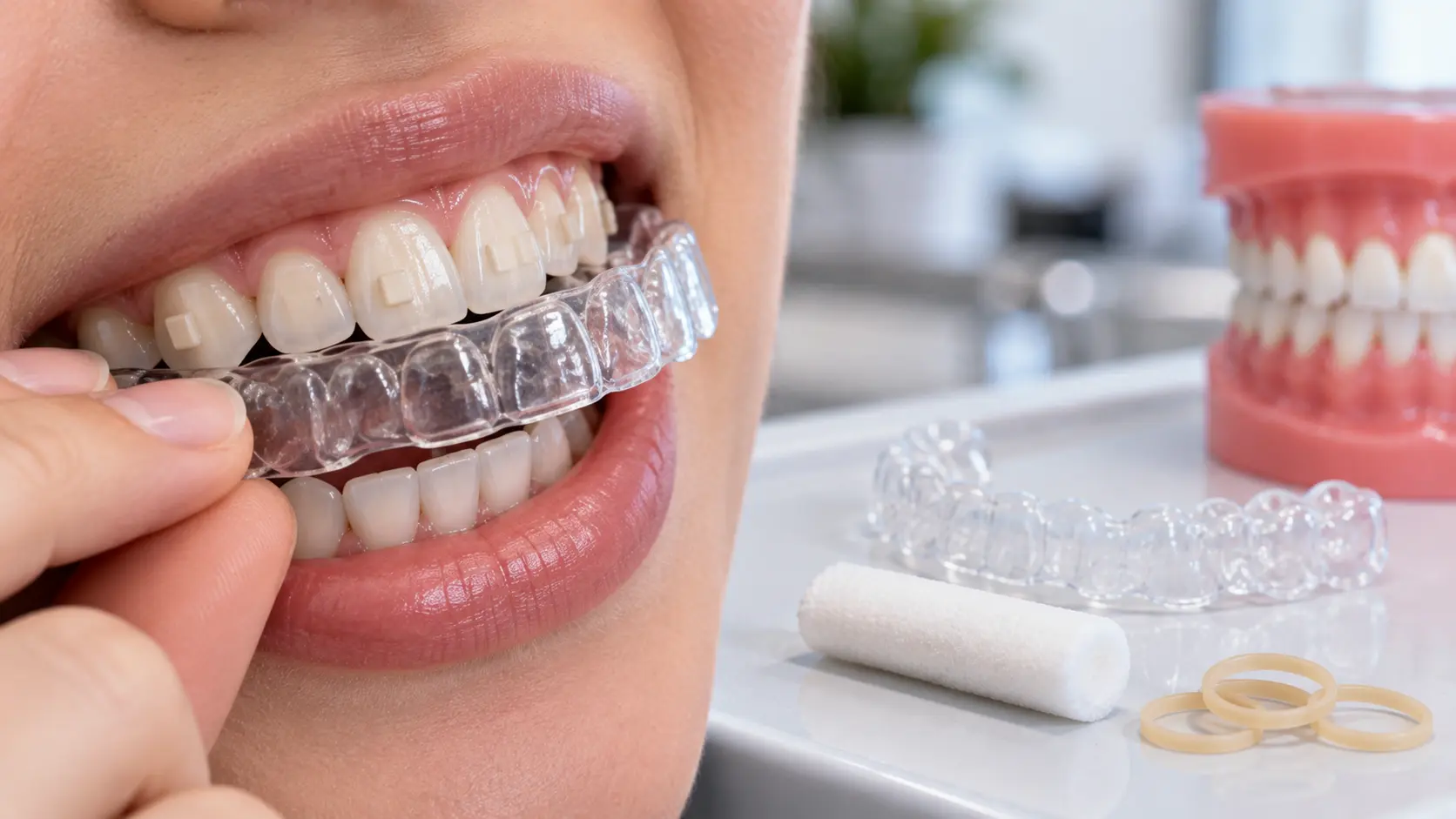
In clear aligner treatment, attachments are small tooth colored elements that are directly bonded to the teeth. Attachments can help the aligners apply the forces needed for certain movements of the teeth. The shape and position of attachments are determined by the type of movement. Compared to orthodontic brackets, attachments are relatively invisible.
To quote the American Association of Orthodontists, small, tooth-colored features are placed on teeth to help move teeth in the appropriate direction.
Although tooth-colored attachments can help aligners move the teeth, they do not necessarily replace the need for brackets and wires in all cases.
Why Are Attachments Used?
Clear aligners work by gradually moving teeth into the desired position with a series of custom-fitted aligners. Certain tooth movements may require additional control. Attachments are small pieces that are bonded to teeth and provide a surface to which an aligner can be adjusted to provide a predetermined force to help move teeth.
There are many circumstances that may require the use of attachments to help move teeth. These may include tooth movement in a particular direction, teeth that need to be rotated or teeth that need to be tipped.
Attachments are often part of many aligner therapy cases, and are not always indicative of a complex case.
How Do Aligner Attachments Work?
The features temporarily bonded to certain teeth are known as aligner attachments. When the bonded features, also known as attachments, are designed in conjunction with the clear aligner, tooth movement in the desired direction is achieved. Effectively, this helps guide the tooth in the right direction.
What Does an Attachment for Aligners Look Like?
Attachment for aligners is a tooth colored, raised bump, molded to a particular tooth shape.
The characteristics of these attachments can vary, and they may be hard to find if they are placed on less visible areas of the tooth. Some may be larger and more noticeable.
Removable attachments are temporary and are taken off during the end of treatment or when no longer needed.
What Is an Attachment Aligner?
Clears aligners are designed to be worn over teeth with attachments. Therefore, they are sometimes referred to as attachment aligners.
An aligner fuses with the attachments via a small connection. This gives the orthodontist a stronger point of contact to maneuver teeth in relation to the others during treatment.
Having attachments on your teeth may feel odd when you first get your aligners. It may be hard to put in or take out your aligners at first. This may feel uncomfortable but you will get used to it after a while.
What Are Invisalign Chewies?
Other accessories, like invisalign chewies, are provided by Invisalign to help move and shape the aligners into place. Chewies are small, flexible, and soft objects that can be bit on.
Invisalign’s aligner-seating products are made from medical-grade silicone. These products help in reducing the spaces present between the teeth and the aligner.
These products additionally help to refine the fit of the aligner tray.
Why Might Your Orthodontist Recommend Chewies?
For a clear aligner to move teeth, the aligner has to take a full load against the teeth. If there is even a slight space between the aligner and the teeth, the aligner will not work. In that situation, your orthodontist may ask you to use an aligner-seating tool.
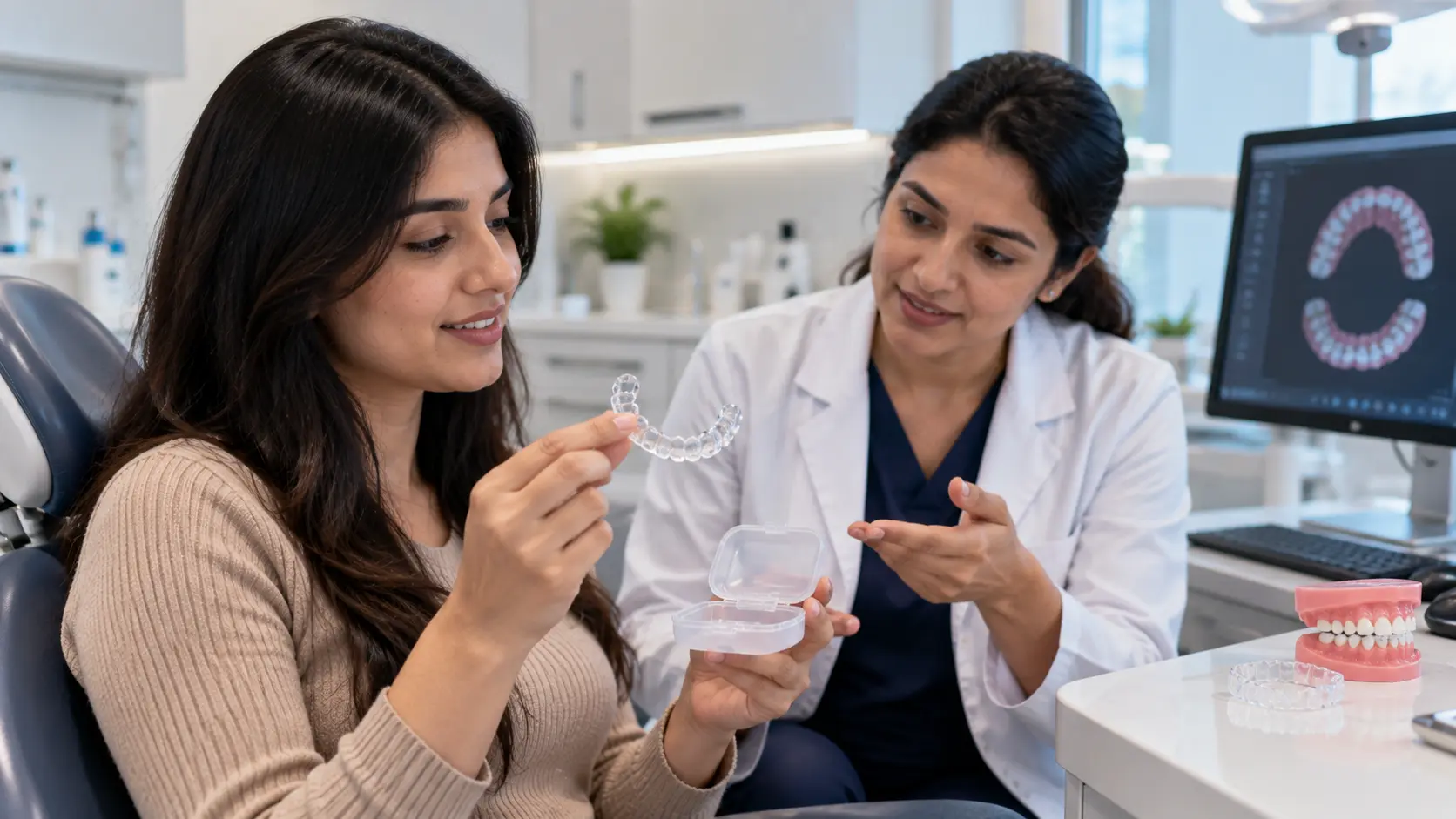
An aligner-seating tool looks kind of like a mouthguard. You may have to bite down on the tool in different locations to seat your aligners.
Chewies and aligner-seating tools both help aligners seat better against your teeth. Your orthodontist will determine what is best for your treatment.
What Are Invisalign Rubber Bands?
Some Invisalign treatment plans utilize small orthodontic elastics, also known as rubber bands, to move teeth into desired positions.
Rubber bands can connect any part of the upper and lower teeth, or other attachment points, to create the desired force.
According to the American Association of Orthodontists, orthodontic elastics create additional force for moving teeth or helping to align the jaws. Prescription of orthodontic elastics is based on the individual’s needs for tooth movement.
What Are Invisalign Elastics Used For?
When extra force is needed in certain situations, like correcting a bite or changing the position of teeth, invisalign elastics are used.
Correcting the relationship between the upper and lower teeth is called a protraction. Protraction is only one type of relation between the upper and lower teeth that may require elastic wear.
The elastics are attached to and worn between specific positions as designated by the orthodontist. Patients must not change the position of the elastics or wear extra elastics without the orthodontist’s directions.
Invisalign and Rubber Bands: How Do They Work Together?
Some treatment plans utilize Invisalign aligners and rubber bands simultaneously.
Aligners are shaped in such a way that they can move teeth in a particular manner. Rubber bands can provide a different or additional force for moving teeth to help correct the bite.
Not all patients require the use of rubber bands. Use depends on the position of the teeth, the type of bite and the desired outcome of treatment.
It is essential to wear the rubber bands as prescribed. The AAO notes that patients should not wear rubber bands for an increased or prolonged duration as this may cause undue stress on the teeth and/or jaws and impede or restrict the movement of teeth in an undesirable and unintended way.
Does Every Invisalign Patient Need Attachments, Chewies or Elastics?
No. Not every Invisalign patient will use all these features.
Some patients may only use clear aligners. Others may use aligners that are the same, but with attachments to assist in tooth movement. Others may require elastics for correcting bite issues.
The types of things that may affect the use of these other features may include the following:
- Tooth position
- Amount of crowding or spacing
- Type of bite problem
- Planned tooth movements
- Treatment goals
- Previous orthodontic treatment
- Individual response during treatment
For these reasons, an Invisalign treatment plan must be customized after an orthodontic assessment, as opposed to based on another patient’s treatment experience, photos, or other related factors.
What Should Patients Expect When They Have Attachments?
Your orthodontist will explain the purpose and placement of attachments on your teeth and how to remove and re-insert your aligners during each new aligner set up.
You may find:
- Your teeth feel slightly different when the aligners are removed
- The attachments are more noticeable without the aligners
- The aligners need to be seated carefully
- Removing the aligners may require some practice
- Certain attachments may feel more noticeable than others
You get used to putting the aligners in and taking them out.
If an attachment comes off, you should contact your orthodontist. Trying to put a new attachment on your own can be dangerous and may cause damage to your other teeth.
Caring for Invisalign Attachments and Aligners
Good oral hygiene is important to maintain during treatment with clear aligners.
Practical habits include:
- Brush your teeth as recommended by your dental professional
- Clean your aligners according to the instructions provided
- Remove aligners when eating if instructed to do so
- Keep aligners in their case when they are not being worn
- Avoid exposing aligners to excessive heat
- Follow the prescribed wearing schedule
- Attend scheduled orthodontic appointments
If your orthodontist has provided you with elastics, make sure you are wearing them according to your orthodontist’s recommendations.
What If an Aligner Does Not Fit Properly?
A newly supplied aligner may feel tighter because it is designed to move your teeth in the next step of your treatment. If, however, it does not go on easily and there is a significant gap, or it is uncomfortable, contact your orthodontist.
Do not try to bend the aligner to make it fit or remove any attachment. Your orthodontist will check if the problem is with the seating of the aligner, the attachment or the aligner itself and make changes to your treatment accordingly.
Why Your Invisalign Plan May Look Different From Someone Else’s
You may see a classmate or celebrity undergoing Invisalign, and notice a difference between your treatment between aligners, attachments, or elastics.
Factors such as attachments and elastics are unique to the case and may differ from patient to patient.
There can even be cases where patients with comparable looking malaligned teeth have differences in their functional and comprehensive movements and relationships. Therefore, no two cases are comparable and treatment is individualized based on the needs of the patient.
Understanding the Components of Your Invisalign Treatment
Understanding the basics of attachments, chewies, and elastics will help you become more comfortable with your Invisalign process. Knowing your treatment plan includes one or more of these elements, do not feel anxious or overwhelmed, talk with your orthodontist and ask for more information. They will be happy to help.
For patients in Pune considering clear aligner treatment, a professional assessment can help determine whether Invisalign is appropriate and whether features such as attachments or elastics may be part of the treatment plan. Dr Mathesul Invisalign orthodontist braces & dental implant clinic provides Invisalign and orthodontic care in Pune with treatment plans based on individual patient requirements.
Contact Dr. Mathesul Invisalign Orthodontist Braces & Dental Implant Clinic to discuss your concerns and understand which approach may be appropriate for you. Take the first step toward better oral health and informed orthodontic care.
Call us today at 8983101099 or email us at dailydentist@gmail.com to book your consultation.
Final Thoughts
During treatment with clear aligners, your orthodontist may use several different tools. You may require the use of Invisalign attachments in addition to Chewies and elastics.
Invisalign attachments are an important feature of the clear aligner system. Chewies are not. Attachments may be used to provide additional tooth movement contacts. Chewies may be used to ensure a proper seal of the aligner to the dental arch and elastics may be used to provide additional load systems to enhance movement of the jaws or assist in the movement of individual teeth.
Knowing the rationale for the use of each of these features of the clear aligner system can help you understand the specifics of your treatment. It is important to follow your orthodontist’s instructions to help ensure the best outcome of your care.